Most high-net-worth Koreans spend years focused on one question: "How do I make more?" But there is a second question that is equally — if not more — important, and most people never ask it seriously:
"How much of what I've already built is silently disappearing?"
In 2026, with the KRW/USD exchange rate hovering near ₩1,500 and South Korea's CPI rising to 2.2% year-on-year in March (Bank of Korea, 2026), the answer to that question is increasingly uncomfortable for anyone holding a KRW-only portfolio. This guide from Gain Lab — Korea's Asset Strategy Institute — breaks down why inflation and currency risk are the hidden enemies of inheritance planning, and what Korean investors can actually do about it.
1. The Silent Tax: What Inflation Is Really Doing to Your KRW Wealth

Inflation does not send a bill. It does not show up as a line item on your bank statement. But it is extracting value from your savings every single month, silently and consistently.
Consider this: South Korea's cumulative inflation since 1965 has eroded the purchasing power of the Korean Won by over 97%. What ₩100 could buy in 1965 requires nearly ₩4,749 today. While this is an extreme long-term example, the principle applies to every asset holder right now — especially those planning wealth transfer over a 10 to 20-year horizon.
📌 The Real Inflation Risk for Korean Asset Holders in 2026
• South Korea CPI (March 2026): +2.2% year-on-year
• KRW/USD exchange rate: approximately ₩1,500 (near 17-year high)
• Bank of Korea base rate: 2.5% (held steady, 6th consecutive meeting)
• South Korea's Middle East oil import dependency: ~70% of total crude imports
Why KRW Is Structurally Vulnerable
The Korean Won is uniquely exposed to two compounding forces that most global currencies do not face simultaneously. First, South Korea is a trade-dependent economy — meaning that when global energy prices spike (as they have following the 2026 US-Iran conflict), import costs rise sharply, putting direct pressure on the KRW. Second, the persistent interest rate differential between the US Federal Reserve and the Bank of Korea creates a structural incentive for capital to flow out of KRW-denominated assets toward USD-denominated ones.
The result: even if your Korean real estate or savings account shows the same nominal number it did five years ago, its purchasing power in global terms has declined significantly. For inheritance planning purposes, this is not an abstract concern — it is a structural threat to the real value you intend to pass on.
2. Why Succession Planning Cannot Ignore Currency Risk
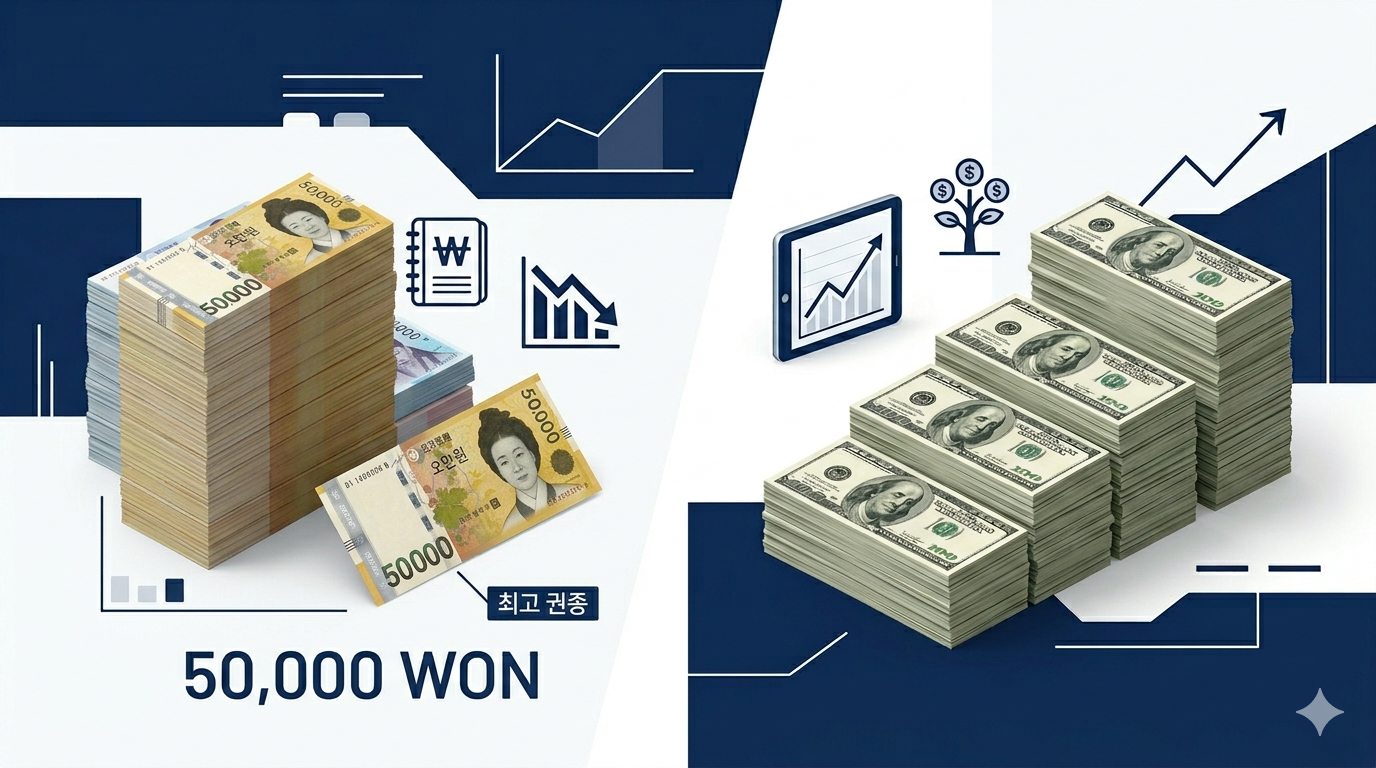
South Korea has one of the highest inheritance tax rates in the OECD — a maximum of 50%, rising to 60% with the largest shareholder surcharge. This alone makes succession planning complex. But when you layer currency risk on top of inheritance tax exposure, the challenge becomes even more acute.
The 20-Year Wealth Transfer Problem
Imagine you are planning to transfer ₩5 billion in assets to your children 15 to 20 years from now. The nominal value may remain at ₩5 billion — or even grow. But if the KRW continues on its current structural trajectory, the USD-equivalent of that wealth could be significantly lower than it is today. Your heirs may receive the same number, but less actual purchasing power in a globalized world.
| Scenario | Asset Value (KRW) | USD Equivalent at ₩1,200 | USD Equivalent at ₩1,500 |
|---|---|---|---|
| Current (2026) | ₩5,000,000,000 | $4,167,000 | $3,333,000 |
| Hypothetical (₩1,800) | ₩5,000,000,000 | — | $2,778,000 |
| Difference | ₩0 (unchanged) | Real value loss: up to 33%+ | |
The numbers are the same. The wealth is not. This is why currency diversification is not a speculative strategy — it is a defensive necessity for any serious succession plan.
South Korea's Unique Inheritance Tax Liquidity Problem
Korean inheritance tax must be paid — in principle — within 6 months of death, in cash. For asset-rich families whose wealth is concentrated in real estate and KRW-denominated assets, this creates a dangerous liquidity trap. If the KRW weakens further at the moment of inheritance, the tax burden in real purchasing power terms becomes even heavier. Holding a portion of assets in USD or USD-denominated instruments provides a natural hedge against this scenario.
3. Practical USD Hedging Strategies for Korean Investors
Currency diversification does not require moving your entire portfolio offshore or navigating complex legal structures. Here are four approaches accessible to most Korean investors, from simplest to most sophisticated.
Strategy 1 — Dollar-Cost Averaging into USD
The simplest entry point. Open a foreign currency savings account at any major Korean bank and set up automatic monthly purchases of USD. This removes the psychological pressure of "timing" the exchange rate and builds dollar exposure steadily over time. The goal is not to profit from exchange rate movements — it is to ensure that a portion of your portfolio is denominated in the world's reserve currency.
Strategy 2 — Korea-Listed USD ETFs
For investors who want USD exposure without the complexity of foreign currency accounts or international brokerage, Korea Stock Exchange (KRX)-listed USD ETFs offer a direct solution. These are purchased in KRW through any Korean brokerage app, require no foreign currency reporting, and provide immediate dollar exposure.
- TIGER U.S. Dollar Short-Term Bond Active: Tracks USD short-term bond yields. Low volatility, suitable as a cash equivalent.
- KODEX USD Futures: Tracks the USD futures index. More direct exchange rate exposure.
- ACE U.S. Dollar SOFR Rate Active: Linked to USD short-term interest rates. Combines currency hedge with interest income.
Strategy 3 — U.S.-Listed Assets via Korean Brokerage
Korean retail investors can purchase US-listed stocks and ETFs directly through their existing Korean brokerage accounts. This includes broad market instruments like S&P 500 index funds, dividend-focused ETFs, and US short-term Treasury ETFs. Capital gains on overseas stocks exceeding ₩2.5 million annually are subject to a 22% capital gains tax in Korea (including local tax), which must be self-reported each May.
Strategy 4 — Corporate Structure for USD Asset Holding
For business owners with an existing corporate entity, holding USD-denominated assets through the corporation can offer tax and succession planning advantages. Corporate foreign exchange gains are taxed under corporate income tax rules, which in some cases offer more favorable treatment than personal income tax. Additionally, corporate-held assets can be structured for gradual succession through share transfers, reducing the liquidity pressure at the time of inheritance. This strategy requires careful design with a qualified tax accountant and legal advisor.
4. How Much USD Exposure Is Right for You?
There is no universal answer, but there are useful reference points. Global institutional investors typically maintain a meaningful allocation to non-domestic currency assets as a structural hedge. For Korean individual investors, the appropriate level depends on several factors.
| Profile | Suggested USD Exposure Range | Primary Instrument |
|---|---|---|
| Conservative (capital preservation focus) | 10–20% of liquid assets | USD savings account, USD ETF |
| Balanced (growth + defense) | 20–35% of total portfolio | USD ETF + US-listed stocks |
| Succession-focused (10–20 year horizon) | 30–50% of transferable assets | Corporate structure + US assets |
These are starting points for discussion, not prescriptions. Individual circumstances — existing asset structure, tax situation, family composition, and time horizon — all affect the optimal allocation. Working with a certified financial planner (CFP) or tax accountant familiar with cross-border asset management is strongly recommended.
Frequently Asked Questions
Inflation is the tax you never voted for. Every year that your wealth sits entirely in KRW-denominated assets, you are making an implicit bet that the Korean Won will hold its value against global currencies, global energy prices, and US monetary policy — simultaneously. That is a bet that history has not consistently rewarded. Currency diversification is not a luxury for sophisticated investors. It is a foundational element of any serious long-term wealth preservation and succession strategy. Start small, start now, and build the hedge that protects not just your money — but its power.